|
Abu Dhabi, 04 February 2026: The Environment Agency - Abu Dhabi (EAD) has launched the Hamdan bin Zayed: The World’s Richest Seas initiative. This programme aims to significantly increase fish stocks in the emirate, seeking to achieve one of the highest densities globally by 2030. The announcement was made on the occasion of the UAE’s National Environment Day and coincided with a major environmental milestone for Abu Dhabi with the achievement of 100 per cent in the Sustainable Fishing Index by the end of 2025, compared to just 8 per cent in 2018, during the meeting of the Global Councils for Sustainable Development Goals, held on the sidelines of the World Government Summit 2026, which was chaired by Her Excellency Ohood bint Khalfan Al Roumi, Minister of State for Government Development and the Future, Chair of the Global Councils for Sustainable Development Goals. The heads of the global councils from 17 countries and the vice-chairs of the councils - mostly high-level UAE government officials ¬- were also present at the meeting. This transformative progress reflects the success of the integrated regulatory and scientific approach adopted by the emirate over recent years. It has played a pivotal role in safeguarding and sustaining marine resources, while strengthening the national food security ecosystem by increasing the abundance of local fish stocks and ensuring the availability of natural, renewable food sources for the community. His Highness Sheikh Hamdan bin Zayed Al Nahyan, Ruler’s Representative in the Al Dhafra Region and Chairman of the Board of the Environment Agency - Abu Dhabi, affirmed that this achievement reflects the strong support the agency receives from His Highness Sheikh Mohamed bin Zayed Al Nahyan, President of the UAE. His Highness noted that achieving a 100 per cent Sustainable Fishing Index marks a pivotal milestone in Abu Dhabi’s journey to safeguard its marine resources. His Highness said: “The launch of this initiative represents a continuation of an approach grounded in science, innovation and the regulation of marine practices - one that enhances the sea’s productivity while preserving its natural balance for the benefit of future generations and contributes to strengthening our food security.”
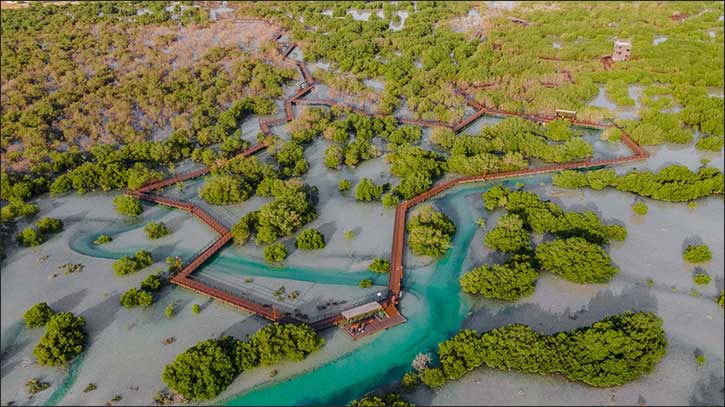
As part of efforts to enhance productive marine habitats, Abu Dhabi Coral Gardens is one of the initiative’s flagship projects. The programme aims to establish new marine sites and underwater gardens through the deployment of 40,000 artificial reef modules, with the number set to rise to 80,000 by 2030, supported by partnerships across multiple sectors. These efforts will create a resilient marine infrastructure capable of attracting fish, increasing biodiversity and strengthening natural productivity across the emirate’s waters. These efforts are reinforced by a suite of complementary initiatives, most notably the Coral Rehabilitation Project, which aims to increase the number of cultivated coral colonies to four million, alongside the Abu Dhabi Mangrove Initiative, which targets the planting of 50 million mangrove trees by 2030. Together, these initiatives harness advanced technologies and artificial intelligence applications for monitoring, analysis and the identification of optimal development sites, ensuring the greatest possible environmental impact. In doing so, they contribute to building a sustainable food system rooted in healthy marine ecosystems. His Excellency Mohamed bin Ahmed Al Bowardi, Vice Chairman of the Board of the Environment Agency - Abu Dhabi, affirmed that the initiative represents a natural extension of the emirate’s achievements in fisheries management. He noted that the remarkable rise in the Sustainable Fishing Index - from 8 per cent to 100 per cent in just six years - demonstrates the effectiveness of the regulatory policies adopted by Abu Dhabi. His Excellency said: “The initiative provides an integrated framework that brings together the protection of marine habitats with the development of fish stocks. It strengthens the sustainable use of natural resources in line with the highest international standards, firmly anchoring the contribution of fisheries to national food security.” Her Excellency Dr Shaikha Salem Al Dhaheri, Secretary General of the Environment Agency - Abu Dhabi, said: “The initiative embodies a clear vision to build a more productive and sustainable marine ecosystem, guided and supported by the direction of our wise leadership. Expanding the network of protected areas to cover 20 per cent of the emirate’s total area represents one of the initiative’s core pillars, providing effective protection for sensitive habitats and strengthening their capacity for natural regeneration. “The agency continues to implement high-impact programmes grounded in science and innovation, including the establishment of Abu Dhabi Coral Gardens, the deployment of artificial reef modules, the regulation of fishing practices and the enhancement of fish stocks. This will ensure the achievement of the initiative's goals by 2030.” The Hamdan bin Zayed: The World’s Richest Seas initiative further cements Abu Dhabi’s position as a global benchmark for the sustainable management of natural resources. By strengthening scientific monitoring and assessment programmes, building local and international partnerships that safeguard marine ecosystems and ensure their long-term resilience and supporting the national food security system through the sustained growth and renewal of natural resources, it ensures that the sea will remain a vital lifeline for the community for generations to come.
| 

 RSS Feed